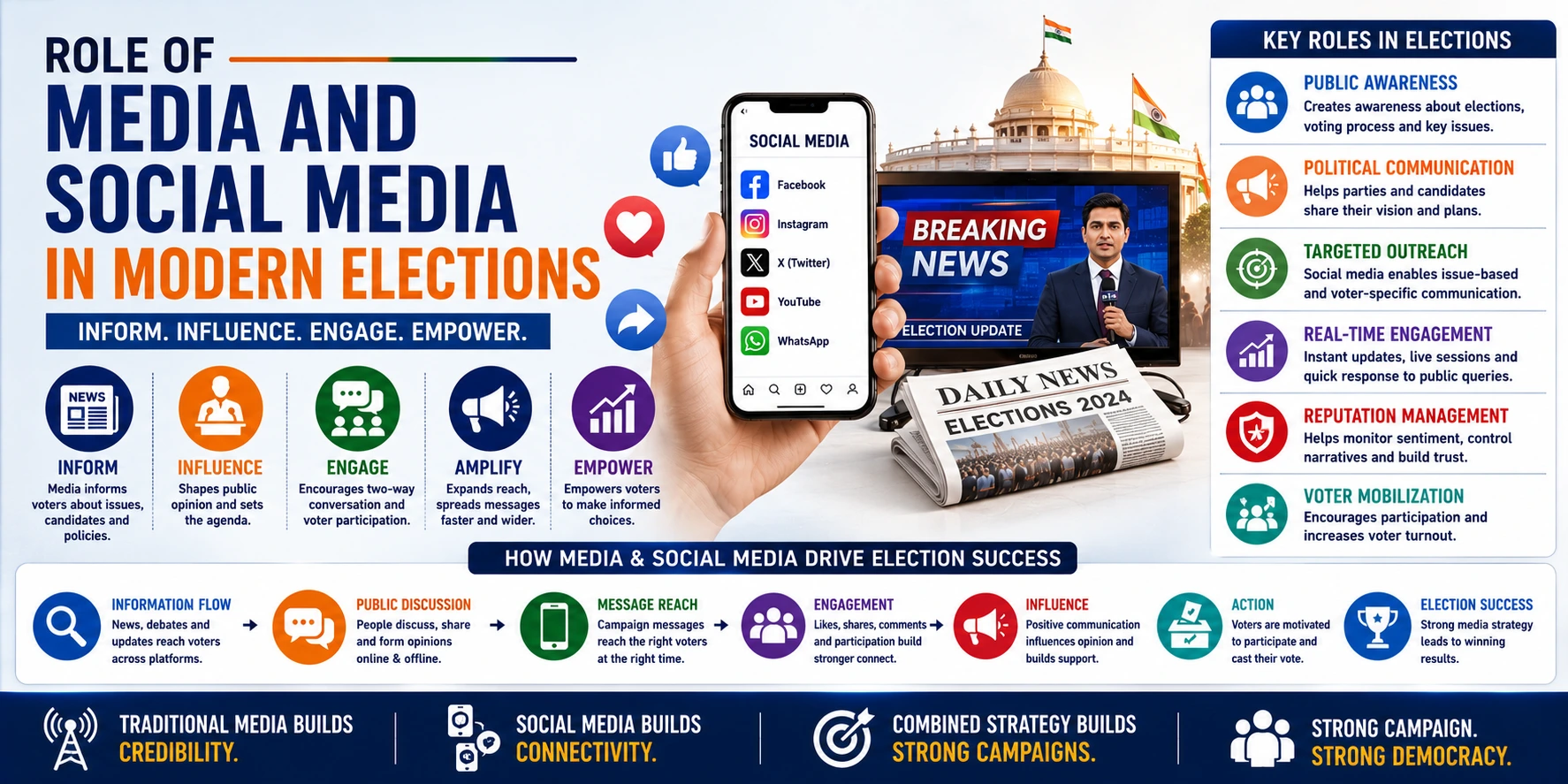
Media and social media have transformed the way election-related information is created, distributed, discussed and monitored. Citizens today may receive political and election information through newspapers, television, radio, digital news platforms, official websites, social media, video platforms, messaging services and public events . Traditional media continues to perform important journalism, reporting, interviewing and public-information functions, while digital platforms allow political parties, candidates and organizations to publish information through their own official channels. The modern election communication environment therefore requires much more than simply publishing content. It requires research, verification, communication planning, media coordination, content governance, monitoring, digital security and responsible response systems .
What is the Role of Media in Elections?
Media provides information about political parties, candidates, policies, manifestos, public issues, election developments, interviews, debates and other matters of public interest.
Traditional media includes:
- Newspapers
- Television news
- Radio
- Magazines
- Regional media
- Local publications
- News agencies
- Professional digital news organizations
Independent journalism can also examine claims, question political representatives, report public concerns and provide different perspectives on political developments.
What is the Role of Social Media in Elections?
Social media provides political organizations with direct digital publishing channels through which approved information can be communicated without relying exclusively on traditional media.
These channels may be used for:
- Official campaign updates
- Public statements
- Speech and event videos
- Press information
- Public meeting schedules
- Policy information
- Candidate interviews
- Public FAQs
- Live public events
- Corrections and clarifications
Social media also creates interactive public spaces where users can comment, question, share and discuss political information.
Media and social media should not be viewed only as tools for visibility. In a modern election environment, they form part of a broader public-information ecosystem. Effective communication therefore depends on factual accuracy, clear attribution, responsible publishing, monitoring and the ability to correct significant errors quickly.
Why Media and Social Media Matter in Modern Elections
Elections generate large volumes of public information within short periods. Media and digital platforms help citizens access information about political developments while giving candidates and organizations channels through which they can communicate official positions and activities.
- Distribute election-related public information
- Communicate policies and public positions
- Provide access to speeches and interviews
- Report public and local issues
- Provide updates about political activities
- Enable public questions and discussion
- Support timely factual clarification
- Provide channels for official communication
- Document important political developments
- Support public awareness of election processes
Traditional Media vs Social Media in Elections
Traditional Media
Includes newspapers, television, radio, magazines and professional news organizations. Content normally passes through editorial and journalistic processes before publication.
Social Media
Provides fast digital publishing and interaction through official political accounts, video platforms, social networks and other online communication channels.
Neither channel replaces the other. Modern political communication often operates across both traditional and digital media.
Key Differences Between Traditional and Social Media
Publishing Process
Traditional media generally uses editorial processes, while official social accounts can publish directly.
Speed
Social platforms can distribute information almost immediately after publication.
Interaction
Social platforms allow comments, questions and other forms of direct public interaction.
Format
Digital channels support text, graphics, short videos, livestreams and long-form video.
Measurement
Digital platforms provide operational metrics such as views, reach and engagement.
Information Risk
Rapid distribution can also allow inaccurate information to spread before verification.
The Modern Election Media Ecosystem
Election communication is no longer controlled by one medium. Information can move between multiple channels within minutes.
Political Event → Official Communication → News Coverage → Social Distribution → Public Discussion → Monitoring → Clarification / Follow-Up
A statement delivered at a public event may appear on television, be reported by digital news organizations, be clipped into short videos and then be discussed across multiple social platforms.
This interconnected environment makes communication coordination and factual consistency increasingly important.
How Professional Election Media Communication Works
Role of Media in Political Public Relations
Media relations is a major part of political public relations. Professional PR teams help organize communication between political organizations and news media.
Activities may include:
- Press releases
- Official statements
- Press conferences
- Media briefings
- Interview coordination
- Fact sheets
- Event information
- Media enquiry management
- Corrections and clarifications
- Media monitoring
Learn more: What is Public Relations in Politics?
Social Media as a Political Communication Channel
Political organizations can use official social media channels to publish verified information about their activities, positions, events and public statements.
Common content formats include:
- Text updates
- Public statements
- Graphics and information cards
- Short videos
- Long-form videos
- Livestreams
- Event photographs
- Press conference clips
- Website links
- Public FAQs
Role of Video in Modern Political Communication
Video has become an important format because speeches, interviews, public meetings, press conferences and informational material can be published in both short and long formats.
Video communication may include:
- Full speeches
- Interview recordings
- Press briefings
- Short informational videos
- Event coverage
- Public issue explainers
- Official statements
- Livestreams
Political video content should preserve sufficient context and should not use deceptive editing that materially changes the meaning of a statement or event.
Role of Official Websites in Election Communication
Social platforms are useful for rapid distribution, but an official website can serve as a stable reference point for verified information.
A political website can organize:
- Candidate or organization information
- Official statements
- Policy documents
- Press releases
- Event information
- Public work documentation
- Media resources
- Frequently asked questions
- Contact information
Media and Election Awareness
Media organizations, election authorities and other legitimate public-information sources can help citizens understand election schedules, candidates, public issues and voting procedures.
It is important to distinguish between official election administration information and campaign communication.
Official information about electoral rolls, polling stations, polling procedures and election administration should be obtained from the relevant election authorities.
Social Media and Political Branding
Branding helps maintain a recognizable and consistent public identity across official communication channels.
It can include:
- Consistent logos and visual identity
- Standard typography
- Approved profile information
- Consistent account naming
- Official photographs
- Standard communication templates
- Clear identification of official accounts
Political branding should support authentic identity and clear communication rather than misrepresenting a candidate or organization.
Related: What is Political Branding?
Media and Candidate Image Management
A candidate's public identity is influenced by many factors, including public work, statements, conduct, interviews, photographs, speeches and official digital communication.
Professional communication teams can help maintain:
- Accurate candidate profiles
- Consistent official information
- Professional media preparation
- Organized public-work documentation
- Clear issue communication
- Responsible crisis communication
Social Media and Digital Campaign Operations
Social media can form one part of a larger digital communication system that also includes websites, video platforms, content management, digital advertising and analytics.
Operational activities may include:
- Content calendars
- Creative asset management
- Video publishing
- Website coordination
- Official social account management
- Advertising administration
- Analytics reporting
- Digital monitoring
Paid political advertising should follow applicable election, advertising and platform requirements.
Explore: Digital Promotion Services .
Role of Analytics in Social Media Management
Digital platforms provide operational metrics that can help teams understand how published content and communication channels are functioning.
Metrics may include:
- Content views
- Video completion
- Website visits
- Public interactions
- Content publishing frequency
- Response times
- Platform-level reach
- Traffic sources
Analytics should be interpreted carefully. High views or engagement do not automatically represent public opinion or election support.
Social Media Analytics vs Political Surveys
Social Media Analytics
Describes activity on a digital platform, such as views, clicks, interactions or video performance.
Political Survey
Uses a structured research methodology and a defined sample to measure opinions or issues within a population.
Social-media activity should therefore not be treated as a substitute for scientifically designed survey research.
Explore: Political Survey Services .
Media and Social Media Monitoring
Monitoring helps political communication teams identify significant news coverage, official mentions, public-information questions and potentially misleading claims.
Monitoring may cover:
- Newspaper coverage
- Television reporting
- Digital news
- Regional media
- Official social account mentions
- Major public-information issues
- Published interviews
- Potential misinformation incidents
Monitoring should focus on relevant public information rather than intrusive profiling of individual users.
Misinformation and Fake Content During Elections
Rapid digital distribution can allow false, misleading or out-of-context material to circulate widely before it is verified.
A responsible communication team should avoid reacting to every unfavorable statement as misinformation. Criticism, opinion and factual disagreement are different from demonstrably false claims.
Detect → Verify Source → Check Evidence → Assess Significance → Prepare Factual Clarification → Approve → Publish → Monitor
AI-Generated and Manipulated Political Content
Artificial intelligence and advanced editing tools can generate or alter text, audio, images and video. This increases the importance of verification before political content is accepted or redistributed as authentic.
Communication teams can maintain:
- Original media archives
- Source records
- Approved versions of official content
- Internal verification procedures
- Clear records of published statements
- Escalation procedures for suspected manipulated content
Media Crisis Management During Elections
Election campaigns can face rapidly developing communication situations involving controversial reports, inaccurate claims, disputed content or unexpected events.
A professional crisis-response process can include:
- Immediate fact verification
- Clear internal escalation
- Authorized spokespersons
- Evidence collection
- Factual response preparation
- Coordinated media communication
- Updates when verified facts change
- Post-event documentation
Digital Security for Political Social Media Accounts
Official political accounts can contain sensitive operational information and have substantial public visibility. Account security should therefore form part of media management.
- Strong unique passwords
- Multi-factor authentication
- Limited administrator access
- Regular access reviews
- Secure recovery information
- Removal of former team access
- Secure storage of original media
- Documented account ownership
Privacy and Data Governance in Digital Political Communication
Digital campaign operations may involve account information, communication records, creative assets, analytics and other organizational data.
Good data-governance practices include:
- Collect only necessary information
- Use appropriate and lawful data sources
- Apply role-based access controls
- Protect account credentials
- Avoid unnecessary sensitive personal profiling
- Maintain secure storage
- Control internal data sharing
- Review applicable privacy requirements
Media and Social Media Compliance During Elections
Political communication during election periods can be subject to election-related requirements in addition to the policies of individual media and digital platforms.
Depending on the activity, teams should review applicable:
- Election laws and directions
- Election Commission requirements
- Model Code requirements when applicable
- Political advertising requirements
- Platform policies
- Content disclosure requirements where applicable
- Media-related requirements
- Privacy and data-protection requirements as applicable
Specific requirements can vary by election, communication format and platform and should be verified for the relevant activity.
Challenges of Media and Social Media in Elections
Misinformation
False or misleading information can circulate quickly across digital channels.
Information Speed
Pressure to respond quickly can conflict with the need for careful verification.
Context Loss
Short clips or edited material can remove important context from longer statements.
Account Security
Unauthorized account access can create serious communication and reputational problems.
Channel Coordination
Multiple official accounts and media teams can create inconsistent information without proper coordination.
Measurement Limits
Digital engagement metrics do not necessarily represent broader public opinion.
Best Practices for Election Media and Social Media Management
- Verify information before publishing
- Clearly identify official accounts
- Use an internal approval workflow
- Maintain consistent factual information
- Keep original media files
- Correct material errors when identified
- Maintain professional media relations
- Protect official digital accounts
- Monitor significant information issues
- Prepare crisis-response procedures
- Maintain communication archives
- Follow applicable election and platform requirements
How Professional Media and Social Media Services Help
Managing modern election communication can require coordination between research teams, content teams, media professionals, digital operators, designers, video teams and campaign management.
Professional support may include:
- Communication assessment
- Media planning
- Press communication
- Content planning
- Digital account management
- Website coordination
- Video communication
- Media monitoring
- Digital analytics
- Information verification
- Crisis communication
- Reporting and documentation
Professional services can help create a more organized communication system, but factual accuracy, legal compliance and responsible communication remain essential.
Megamind's Media & Digital Communication Approach
Megamind approaches media and social media as part of an integrated Political Communication and Election Intelligence System .
Our framework can follow:
Communication Assessment → Research & Issue Understanding → Media Planning → Content Planning → Fact Verification → Media Coordination → Digital Publishing → Monitoring → Analytics → Crisis Response → Reporting & Continuous Review
Depending on project requirements, these activities can be integrated with Public Relations, Political Surveys, Candidate Communication, Digital Promotion and Election Campaign Management .
Megamind supports political parties, candidates, leaders, prospective candidates, aspirants, campaign teams and political organizations with structured media, digital communication and election-related technology solutions across India.
Explore Political PR Services →Integrating Media, Social Media and Ground Communication
Traditional media, official digital channels and field communication should not operate as disconnected systems.
Research → Public Issues → Communication Planning → Media Relations → Digital Communication → Ground Information → Monitoring → Verification → Reporting & Continuous Review
Coordination helps maintain consistency when information is being distributed across several channels at the same time.
Future of Media and Social Media in Elections
Election communication will continue to evolve as digital platforms, artificial intelligence, video technologies, analytics and verification systems develop.
Future communication operations are likely to place increasing importance on:
- Rapid information verification
- Official-source authentication
- Digital security
- AI-assisted content operations
- Manipulated-media detection
- Cross-platform communication management
- Media archives and documentation
- Privacy and data governance
- Responsible use of analytics
Technology can improve operational efficiency, but professional judgment and factual verification remain essential.
FAQs – Media and Social Media in Modern Elections
1. What is the role of media in elections?
Media reports political developments, interviews candidates, examines public issues and provides citizens with election-related information and different perspectives.
2. What is the role of social media in elections?
Social media provides direct digital channels for official updates, statements, videos, events and other political communication while also enabling public discussion.
3. Is social media replacing traditional media?
No. They perform different functions and frequently interact. Traditional journalism and direct digital communication both remain important parts of the information environment.
4. Why is social media important for political communication?
It enables rapid publishing of official information in multiple formats including text, graphics, video and livestreams.
5. What is media monitoring?
Media monitoring is the structured tracking of relevant news coverage, public-information issues, official mentions and significant communication developments.
6. How should misinformation be handled?
Information should first be verified. When a materially false claim requires response, teams can prepare an evidence-based factual clarification through appropriate official channels.
7. What is the role of video in election communication?
Video can document speeches, interviews, public meetings, press conferences, statements and informational material in both short and long formats.
8. Are social media metrics the same as public opinion?
No. Views, likes, shares and comments describe activity on a platform and should not automatically be interpreted as representative public opinion.
9. How are political surveys different from social media analytics?
Political surveys use structured research and defined samples, while social media analytics measures activity occurring on digital platforms.
10. Why is digital security important for political accounts?
Unauthorized access can result in false communication, account loss or exposure of internal information, making strong access controls essential.
11. What is political media crisis management?
It is a structured process for verifying facts, coordinating responsible teams and publishing accurate information during rapidly developing communication situations.
12. Can AI be used in political media operations?
AI can assist with operational tasks such as organization, transcription or analysis, but important political communication should remain subject to human review, verification and applicable requirements.
13. What is the role of an official political website?
It can provide a stable source for candidate information, statements, policy documents, press releases, event information and other verified public material.
14. Do election rules apply to social media?
Election-related communication may be subject to applicable election requirements as well as platform policies. Specific requirements should be checked for the relevant election and activity.
15. How can media and digital communication be coordinated?
Teams can use common information sources, defined approval processes, content calendars, authorized spokespersons and centralized monitoring to improve consistency.
Media and Social Media are Central to Modern Election Communication
Media and social media have become central components of the modern election information environment.
Traditional media provides journalism, interviews, reporting and public scrutiny, while social media gives political organizations direct channels for publishing official information, video, statements and event updates.
Their importance also creates significant responsibilities. Political communication teams need systems for fact verification, media coordination, content approval, monitoring, misinformation response, digital security, privacy and election compliance .
When these functions are coordinated professionally, media and digital platforms can support clearer, more organized and more responsible public communication throughout the election process.