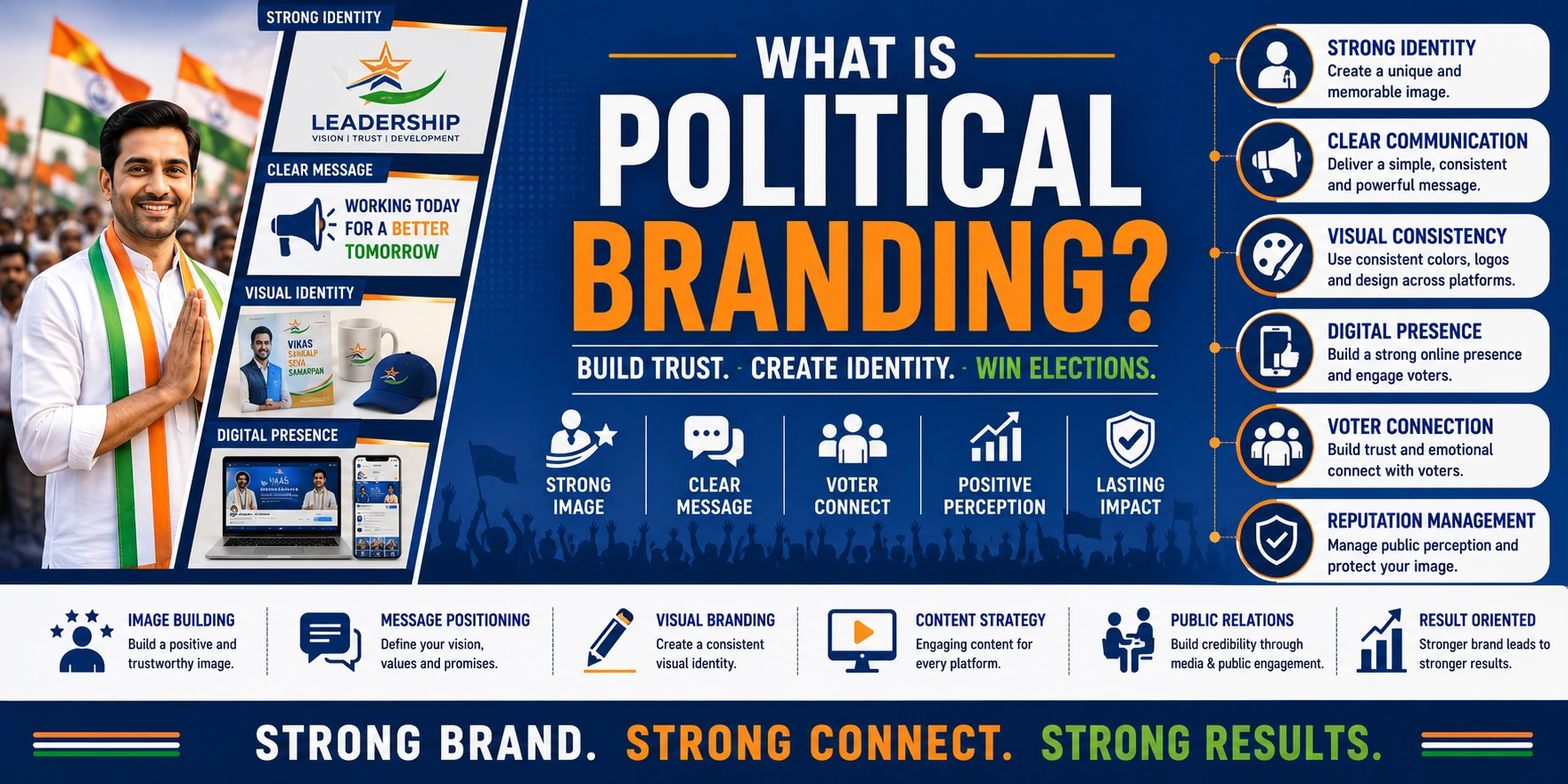
Political Branding is the process of creating, organizing and consistently communicating the public identity of a political candidate, leader, party or campaign. It connects public biography, documented work, leadership priorities, visual identity, speeches, media communication, digital presence, campaign material and public-facing behaviour within one recognizable communication framework. Professional political branding should not be understood merely as creating attractive posters or slogans. A credible political identity is built through authenticity, factual communication, consistency, transparency, responsible public conduct and alignment between what is communicated and what can be demonstrated publicly.
What is Political Branding?
Political branding is the structured management of how a candidate, leader, party or political organization presents its identity across public communication channels.
It can include:
- Candidate or leader profile
- Political identity
- Public biography
- Visual identity
- Communication style
- Website and social profiles
- Media communication
- Public documentation
- Reputation management
- Campaign-content standards
In simple terms, political branding helps ensure that public information about a political figure or organization is presented in a clear, recognizable and consistent manner.
Political Branding is More Than Image Creation
Political branding is sometimes misunderstood as creating an image that is separate from reality.
A sustainable political identity should instead be based on information that can be responsibly supported through:
- Candidate background
- Public record
- Documented work
- Declared priorities
- Official positions
- Public accessibility
- Consistent conduct
- Verified campaign information
Branding can organize and communicate these elements, but it should not depend on fabricated achievements, misleading claims or artificial personality construction.
Strong political branding begins with identity clarity. Before designing posters, websites or digital content, a campaign should clearly document who the candidate or organization is, what public work can be verified, what priorities it communicates and what standards should remain consistent across every channel.
Why Political Branding is Important in Elections
Election campaigns operate across many communication environments: public meetings, local campaign offices, newspapers, television, websites, social media, press conferences, printed material and ground activities.
Without a consistent identity, these channels can present contradictory information or an unclear public profile.
A structured branding system can help:
- Create a consistent public identity
- Improve recognition of official campaign communication
- Maintain visual consistency
- Improve factual message clarity
- Coordinate digital and offline communication
- Organize media-facing information
- Maintain documentation standards
- Support long-term political communication
Main Objectives of Political Branding
Identity Clarity
Define the candidate, leader or organization's public identity clearly and consistently.
Communication Consistency
Maintain consistent factual information across speeches, digital platforms, media and campaign material.
Visual Recognition
Establish standardized design elements for official communication.
Public Information
Present documented work, background, priorities and official positions clearly.
Media Readiness
Maintain organized information and approved communication resources for media interaction.
Long-Term Identity
Develop a political communication system that can remain useful beyond a single election period.
Key Elements of Political Branding
Political Identity
A clear description of the candidate or organization's background, public role and priorities.
Candidate Profile
Accurate and organized public information about experience, work, qualifications and public activity.
Visual Identity
Consistent use of campaign colors, typography, photography, layouts and design standards.
Communication Framework
Structured guidance for speeches, press material, digital posts and public announcements.
Digital Presence
Organized official social profiles, website, digital content and campaign information.
Media Relations
Professional press communication, media documentation and spokesperson preparation.
Ground Consistency
Alignment between public-facing ground activities and official campaign communication.
Reputation Management
Monitoring factual public issues and responding through documented and responsible communication.
Communication Governance
Establishing approval, verification and publishing procedures for official campaign content.
How Political Branding Works – Step by Step
Political Brand Audit
Before creating new branding material, campaign teams should review the political identity that already exists publicly.
A brand audit can review:
- Existing candidate biography
- Official social profiles
- Campaign website
- Photography and visual material
- Press coverage
- Public speeches
- Campaign posters and banners
- Previous campaign communication
- Documented public work
- Outdated or inconsistent information
The objective is to identify communication gaps and inconsistencies, not to manufacture a different identity.
Building an Accurate Candidate Profile
A political brand needs a reliable factual foundation.
A candidate profile may document:
- Personal and professional background
- Education where relevant and verified
- Public-service experience
- Political experience
- Organizational responsibilities
- Documented public initiatives
- Constituency-related work
- Declared public priorities
- Official contact information
- Verified media resources
Important claims should be documented wherever practical so that the same accurate information can be used across websites, media kits, digital profiles and campaign literature.
Political Branding and Candidate Image Management
Political branding and Candidate Image Management are closely related, but they are not exactly the same.
Political Branding
Creates the broader identity system covering visual communication, candidate profile, digital presence, content, media and campaign consistency.
Candidate Image Management
Focuses more specifically on how a candidate's authentic public identity, work, conduct and communication are presented consistently.
Political Identity and Positioning
Political positioning should begin with what a candidate or organization can authentically demonstrate.
It may organize factual information around areas such as:
- Public service
- Administrative experience
- Constituency knowledge
- Organizational experience
- Development priorities
- Accessibility
- Policy interests
- Documented local work
Positioning should not require inventing characteristics that are inconsistent with the candidate's record or public behaviour.
Political Branding and Campaign Communication
Branding creates consistency only when communication teams follow a common information framework.
That framework can define:
- Approved candidate biography
- Official issue positions
- Public programme information
- Verified achievements
- Standard names and designations
- Communication tone
- Frequently asked questions
- Media response procedures
- Content verification process
- Approval responsibilities
This reduces the risk of different campaign teams publishing contradictory or inaccurate information.
Slogans, Taglines and Campaign Language
Slogans and taglines are short communication devices used to summarize a campaign theme or public priority.
Effective campaign language should generally be:
- Clear
- Easy to understand
- Consistent with official positions
- Suitable for multiple communication formats
- Factually supportable where it makes factual claims
- Consistent with the wider campaign identity
A slogan should not substitute for detailed policy information where voters or media require substantive explanation.
Visual Identity in Political Branding
Visual consistency helps distinguish official campaign material from unofficial or outdated communication.
A political visual identity system may define:
- Primary campaign colors
- Secondary colors
- Typography
- Candidate photography standards
- Logo usage where applicable
- Poster layouts
- Social-media templates
- Presentation templates
- Press-document layouts
- Website design consistency
Candidate Photography and Visual Standards
Photography is frequently reused across websites, social media, press releases, posters, brochures and event communication.
Maintaining an organized image library can improve visual consistency.
Useful categories may include:
- Official portrait photographs
- Public programme photographs
- Field-visit photographs
- Meeting photographs
- Press photographs
- Public-service documentation
- High-resolution media images
- Approved campaign visuals
Images should be used with appropriate context and should not intentionally create a misleading representation of an event.
Digital Political Branding
A candidate's digital presence may include many separate channels, making consistency especially important.
Digital branding can cover:
- Official website
- Social-media profiles
- Profile photographs
- Page descriptions
- Official biography
- Campaign videos
- Press and media sections
- Public-work documentation
- Official announcements
- Contact and verification information
Explore Digital Promotion for broader digital campaign communication and content operations.
Role of a Candidate or Campaign Website
An official website can act as a central reference point for public campaign information.
Useful website sections may include:
- Candidate biography
- Public work
- Political priorities
- News and announcements
- Media resources
- Public events
- Official videos
- Contact information
- Policy or programme documents
- Public disclosures where appropriate
Information should be kept current so that outdated webpages do not conflict with newer official communication.
Content Strategy Within Political Branding
Political branding requires an organized content system rather than unrelated posts published from day to day.
Content categories may include:
- Official announcements
- Candidate activity updates
- Documented public work
- Public issue explanations
- Speech excerpts
- Policy information
- Media interviews
- Event information
- Fact-check or clarification posts
- Long-form public information
Important factual claims should be checked before publication and corrected promptly if an error is discovered.
Role of Public Relations in Political Branding
Political branding defines the public identity framework, while Public Relations helps manage structured communication with media and other public information channels.
PR functions can include:
- Press releases
- Media kits
- Candidate background notes
- Interview coordination
- Press conference support
- Statement preparation
- Media monitoring
- Correction and clarification communication
Political Media Kit and Candidate Information Pack
A professional media kit can make accurate information easier for journalists and campaign representatives to access.
It may contain:
- Approved candidate biography
- Official photographs
- Political and professional background
- Public initiatives
- Contact information
- Recent press releases
- Official statements
- Key public documents
Political Branding and Ground Campaigning
Political branding should remain consistent between digital communication and what campaign representatives communicate during field activities.
Ground-facing communication may include:
- Candidate introduction material
- Public information leaflets
- Meeting backdrops
- Campaign-office branding
- Event signage
- Volunteer identification material
- Authorized campaign literature
- Local programme information
This can be coordinated with Grassroots Campaigning and other legitimate field operations.
Digital Branding vs Ground Branding
Digital Branding
Includes websites, official social profiles, videos, graphics, digital documents and online public information.
Ground Branding
Includes printed material, public-event identity, campaign offices, field communication and other physical campaign assets.
Both should use the same approved identity and factual information framework.
Political Reputation Management
Reputation management involves monitoring public information about a candidate or organization and responding appropriately when clarification is required.
Responsible reputation management can involve:
- Media monitoring
- Digital monitoring
- Verification of disputed claims
- Correction of factual errors
- Documented responses
- Official statements
- Media coordination
- Internal escalation
Reputation management should focus on factual clarification and responsible public communication rather than concealing legitimate public information.
Political Branding During a Communication Crisis
Unexpected controversies, inaccurate reports, internal communication errors or rapidly developing events can create pressure on campaign communication teams.
A structured response process can follow:
Identify Issue → Verify Facts → Assess Source → Coordinate Internally → Prepare Accurate Response → Obtain Approval → Publish Through Official Channel → Monitor Further Developments
Speed can be important, but verification should not be sacrificed merely to respond first.
Political Branding and Misinformation Management
Campaigns may encounter false, misleading or manipulated information online.
A responsible workflow can include:
- Record the disputed content
- Verify whether the claim is actually incorrect
- Identify reliable supporting documentation
- Prepare a factual clarification where necessary
- Use official communication channels
- Maintain internal records of significant incidents
- Follow applicable platform procedures where relevant
Campaign teams should avoid responding to misinformation with additional misinformation.
Why Fact Verification Matters in Political Branding
Branding consistency has limited value if the underlying information is inaccurate.
High-impact factual content may require verification before publication, particularly when it refers to:
- Public achievements
- Government programmes
- Statistics
- Election results
- Candidate biography
- Official positions
- Legal or administrative claims
- Statements attributed to other people
Political Brand Guidelines
A written brand guide helps campaign teams maintain consistency even when many designers, field teams, content creators and coordinators are working simultaneously.
A brand guide can define:
- Official candidate naming
- Logo and symbol usage
- Color standards
- Typography
- Photography rules
- Poster layouts
- Social templates
- Video title standards
- Website identity
- Approval procedures
Who Should Approve Political Branding Content?
Large campaigns can reduce communication errors by defining who can create, verify, approve and publish official content.
A simple governance structure might include:
Content Draft → Fact Verification → Communication Review → Authorized Approval → Design / Production → Final Check → Official Publication → Archive
The exact approval structure should depend on campaign size and internal responsibilities.
Importance of a Political Content Library
Campaign teams frequently need the same biographies, images, statistics, documents and approved statements across many channels.
A central content library can maintain:
- Official biographies
- Approved photographs
- Logos and design assets
- Press releases
- Public documents
- Speech references
- Approved statistics
- Video assets
- Campaign presentations
- Archived communication
Version control can help prevent outdated information from being republished.
Monitoring Political Branding
Brand monitoring should focus on whether official campaign communication remains accurate, recognizable and consistent.
Operational checks can include:
- Visual consistency
- Biography consistency
- Correct candidate naming
- Official account consistency
- Website accuracy
- Media-document accuracy
- Outdated content
- Public clarification requirements
- Communication approval compliance
- Digital-account integrity
AI and Political Branding
AI-assisted tools can support some political communication operations, such as content organization, transcription, translation, summarization, asset categorization and workflow assistance.
However, campaign teams should maintain human review for important political communication.
Particular care is appropriate when using AI for:
- Candidate statements
- Public claims
- Images or videos
- Translations
- Statistics
- Media responses
- Official documents
- Crisis communication
Synthetic or edited material should not be used in a way that misleadingly represents real events or statements.
Digital Security and Political Brand Protection
Official campaign accounts and digital assets are part of the political brand and require appropriate security.
- Use strong authentication where available
- Limit administrator access
- Avoid unnecessary credential sharing
- Maintain account-recovery information
- Remove access when team roles change
- Protect website administration
- Maintain secure copies of important assets
- Establish an account-incident escalation process
Political Branding vs Public Relations
Political Branding
Defines the overall identity, visual language, candidate profile, communication framework and public-facing consistency.
Public Relations
Manages organized communication with media and other public information channels, including press releases, interviews and official statements.
The two functions work together but should not be treated as identical.
Political Branding vs Digital Promotion
Political Branding
Defines what the political identity looks and sounds like across communication channels.
Digital Promotion
Handles the operational publication and distribution of approved political content through digital platforms and channels.
Political Branding as a Long-Term Identity
Political identity does not necessarily begin and end with one election.
Maintaining accurate public records, consistent communication, organized digital assets and documented public work can support long-term political communication between election periods.
Long-term political branding may include:
- Regular website updates
- Public-work documentation
- Official social communication
- Media archives
- Issue and policy documentation
- Public programme records
- Photographic archives
- Communication continuity
Benefits of Professional Political Branding
- Creates a clear political identity
- Improves communication consistency
- Standardizes visual presentation
- Organizes candidate information
- Improves media readiness
- Supports digital communication
- Improves documentation quality
- Reduces contradictory public information
- Supports reputation management
- Creates long-term communication continuity
Common Challenges in Political Branding
Inconsistent Information
Different campaign teams may use different biographies, claims or messages.
Weak Visual Standards
Poorly coordinated designs can make official campaign material difficult to recognize.
Outdated Information
Old webpages, bios or campaign assets may conflict with current official information.
Unverified Claims
Publishing unsupported factual claims can create credibility and reputation problems.
Channel Fragmentation
Digital, media and field teams may operate separately without a shared communication framework.
Crisis Response
Rapidly developing controversies can produce inconsistent responses if no approval process exists.
Best Practices for Political Branding
- Build branding around authentic public identity
- Verify major factual claims
- Maintain an approved candidate biography
- Create clear visual-brand guidelines
- Maintain consistent official profile information
- Use professional photography
- Coordinate ground and digital communication
- Maintain a campaign content library
- Use a defined content-approval workflow
- Correct factual errors promptly
- Maintain digital account security
- Review communication regularly
How Professional Political Branding Services Help
Political branding can involve research, communication, design, digital operations, media coordination and continuous monitoring.
Depending on project requirements, professional services may include:
- Political brand audit
- Candidate profile development
- Visual identity framework
- Candidate photography planning
- Campaign communication framework
- Website and digital identity
- Content planning
- Media kit development
- Public relations coordination
- Reputation monitoring
- Communication dashboards
- Brand-governance processes
These activities can operate within a broader Election Campaign Management framework.
Megamind's Approach to Political Branding
Megamind approaches political branding as an integrated identity, communication, design, documentation and reputation management system rather than simply a creative-design exercise.
Depending on project requirements, our framework can follow:
Political Identity Audit → Candidate Profile → Public Record & Communication Review → Brand Identity Framework → Visual System → Content & Media Framework → Digital Integration → Ground Communication Alignment → Monitoring & Reputation Management
Political branding can be integrated with Candidate Image Management, Digital Promotion, Public Relations, Political Communication, Grassroots Campaigning, Campaign Technology and Election Campaign Management according to project requirements.
Megamind provides political research, election communication and campaign-management support for political parties, candidates, leaders, prospective candidates, aspirants, campaign teams and political organizations across India.
Explore Complete Election Services →Political Branding Across Indian Elections
Political branding can be relevant to Lok Sabha, Vidhan Sabha, municipal and other political campaigns across India.
The communication environment can differ considerably across constituencies, states, languages and levels of election.
A political branding framework may therefore need to account for:
- Local language
- Candidate background
- Public record
- Constituency context
- Media environment
- Digital presence
- Ground campaign structure
- Available communication channels
The identity should remain authentic even when the communication format changes between different platforms or regions.
Political Branding, Compliance and Transparency
Political communication should be planned with appropriate attention to applicable election rules, platform requirements, advertising requirements, privacy obligations and other legal or administrative requirements relevant to the specific campaign.
Campaign teams should verify the requirements applicable to the election, communication medium and publication period rather than relying on general assumptions.
Clear approval procedures and documented sources can also help reduce publication errors.
Political Branding Within a Complete Election Campaign
Political branding works best when it remains connected with research, public communication, digital operations, field activity, media relations and campaign management.
Political Research → Candidate Identity → Verified Public Profile → Visual Identity → Communication Framework → Digital & Media Execution → Ground Communication → Monitoring → Reputation & Continuous Review
This approach helps ensure that political communication across different channels remains consistent with the same authentic public identity.
FAQs About Political Branding
1. What is political branding?
Political branding is the structured management of the public identity, visual presentation, communication and digital presence of a candidate, political leader, party or campaign.
2. Why is political branding important?
It helps campaigns maintain consistent candidate information, visual identity, media communication and public-facing materials across different channels.
3. Is political branding only about logos and posters?
No. Visual design is only one part. Political branding also includes candidate profile, communication standards, digital presence, media readiness, reputation management and documentation.
4. What is a political brand audit?
It is a review of existing public information, digital profiles, visuals, candidate biography, media material and campaign communication to identify gaps or inconsistencies.
5. What is candidate identity in political branding?
Candidate identity refers to the authentic public profile built from background, experience, documented work, official priorities and public communication.
6. What is visual identity in a political campaign?
It is the standardized system for campaign colors, typography, photography, layouts, logos where applicable and other official visual assets.
7. What is digital political branding?
It involves maintaining a consistent official identity across websites, social profiles, videos, digital graphics, biographies and online campaign communication.
8. How is political branding different from public relations?
Branding defines the wider public identity framework, while PR focuses more specifically on organized media and public communication.
9. How is political branding different from digital promotion?
Branding defines the identity and communication standards. Digital promotion manages publication and distribution of approved content through digital channels.
10. Why is candidate photography important?
Professional, accurately contextualized photographs create consistent visual assets for websites, media, social platforms and campaign material.
11. What is reputation management in political branding?
It involves monitoring public information, verifying disputed claims and using responsible official communication when factual clarification is necessary.
12. Why should campaign content be verified?
Verification helps reduce factual errors, contradictory claims and reputational problems across official campaign communication.
13. What are political brand guidelines?
They are documented rules covering identity, colors, typography, photography, layouts, naming and content approval so that campaign communication remains consistent.
14. Can political branding continue after an election?
Yes. Public-work documentation, official profiles, media archives and communication systems can support long-term political identity management.
15. Who can use professional political branding services?
Political parties, candidates, leaders, prospective candidates, aspirants, campaign teams and political organizations may use professional political communication and branding support according to project requirements.
Political Branding Builds a Consistent and Authentic Public Identity
Political Branding is much more than designing posters, choosing campaign colors or creating slogans.
A professional political brand connects candidate identity, verified public information, visual presentation, communication, digital presence, media relations, reputation management and ground campaign consistency within one organized system.
The strongest foundation for political branding is authenticity. Public communication should reflect documented work, actual experience, declared priorities and responsible conduct rather than attempting to manufacture an artificial political identity.
When combined with Digital Promotion, Public Relations, Candidate Image Management, Political Communication and Election Campaign Management, political branding can create a more coherent and professionally managed public communication framework.