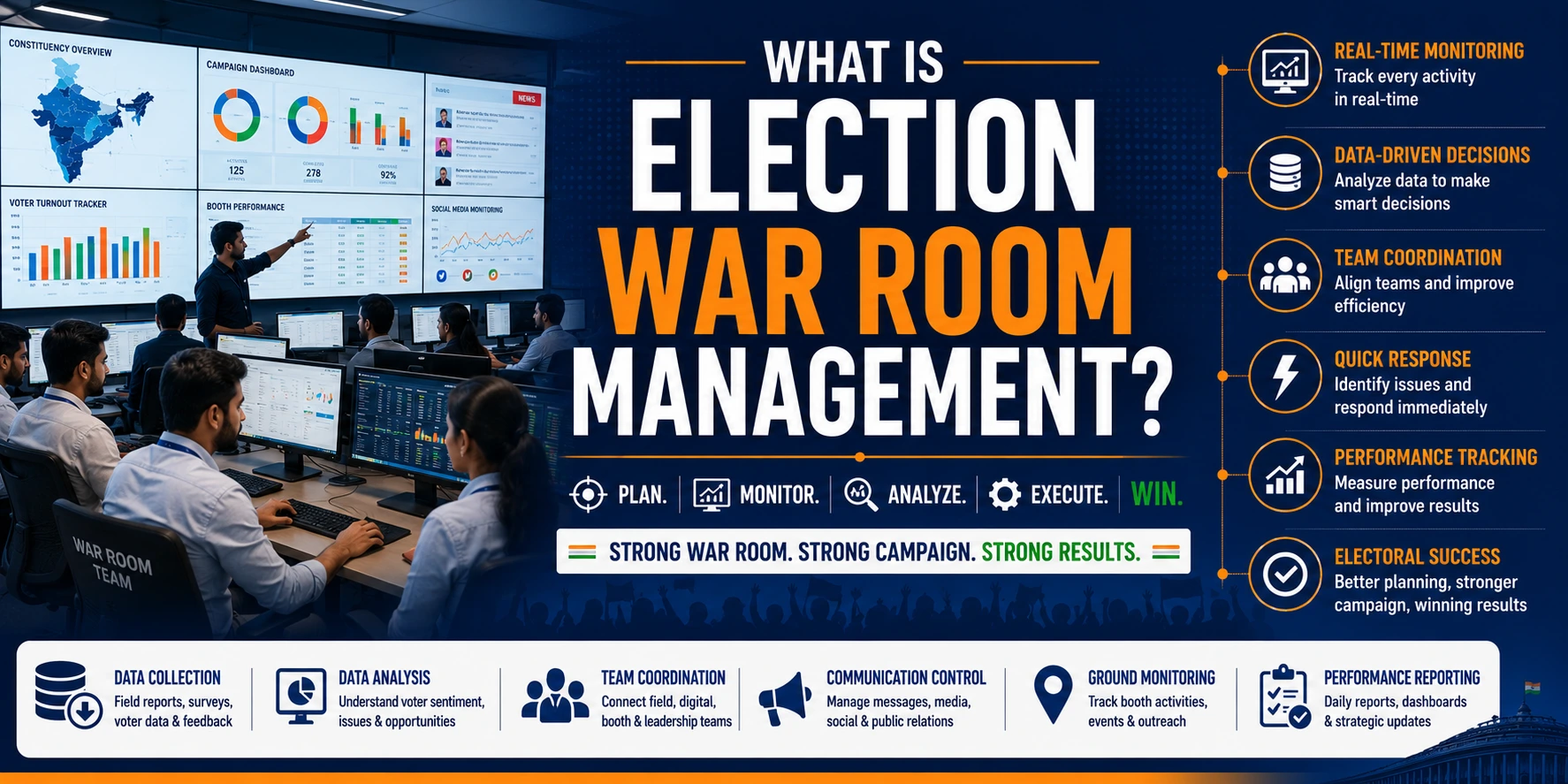
Election War Room Management is the centralized operational system used to coordinate, monitor and review the many moving parts of a political campaign. It brings together campaign operations, field coordination, political research, data analysis, digital monitoring, media communication, issue tracking, reporting and leadership decision support within a structured management framework. A professional war room does not replace field teams or campaign leadership. Its purpose is to make information flow faster, improve coordination, identify operational issues and help decision-makers work with timely and verified information.
What is an Election War Room?
An Election War Room is a centralized campaign coordination and monitoring center where information from multiple campaign functions is collected, reviewed and converted into structured reports, operational alerts and management decisions.
Depending on the size of the campaign, a war room may include:
- Campaign coordinators
- Political research professionals
- Data analysts
- Field coordination teams
- Booth coordination teams
- Digital teams
- Media and PR professionals
- Reporting teams
- Technology support
- Campaign leadership representatives
The exact structure depends on constituency size, campaign scale, election type, available resources and operational requirements.
A war room should not become only a room full of screens and dashboards. Its real value comes from a disciplined Information → Verification → Analysis → Coordination → Action → Monitoring → Review process. Technology supports this process, but people, reporting discipline and clearly defined responsibilities make it work.
Why Election War Room Management is Important
Modern election campaigns can involve hundreds or thousands of activities taking place simultaneously across field, digital, communication, research and organizational teams.
Without a central coordination mechanism, important information may remain fragmented between different teams.
- Centralizes campaign information
- Improves coordination between teams
- Creates structured reporting
- Supports timely operational decisions
- Identifies execution delays
- Tracks campaign activities
- Supports issue escalation
- Improves communication between field and leadership
- Supports media and digital monitoring
- Creates management accountability
Core Objectives of Election War Room Management
Monitoring
Maintain a structured view of campaign activities, field operations, digital channels and important developments.
Coordination
Connect campaign leadership, field teams, research, digital, communication and operational teams.
Decision Support
Provide verified information, research findings and operational reports to decision-makers.
Issue Management
Record, classify, assign and monitor campaign-related issues requiring attention.
Reporting
Produce consistent dashboards, summaries, alerts and management reports.
Review
Compare planned activities with reported execution and identify operational gaps.
Key Functions of an Election War Room
Data & Research
Organizes political surveys, electoral data, field reports and research findings.
Field Monitoring
Reviews scheduled field activities, team reporting and operational coverage.
Booth Coordination
Organizes campaign-side booth-team reporting and geographic field coordination.
Digital Monitoring
Tracks official digital channels, published content, platform metrics and significant online developments.
Media & PR
Coordinates press information, media monitoring, factual clarification and communication workflows.
Issue Tracking
Records important field, public, operational, digital and communication issues.
Task Management
Assigns operational tasks and monitors their status through defined workflows.
Leadership Reporting
Converts large volumes of campaign information into concise management summaries.
Documentation
Maintains records of reports, decisions, communication and campaign operations.
Components of an Effective Election War Room
An effective war room combines people, processes, information and technology rather than depending on any single system.
- Defined command structure
- Clear team responsibilities
- Standard reporting formats
- Political research desk
- Data management system
- Field coordination desk
- Digital monitoring desk
- Media and communication desk
- Issue escalation process
- Campaign dashboards
- Task management system
- Data-security controls
How Election War Room Management Works
A professional war room follows a repeatable information and coordination workflow.
Role of Data in an Election War Room
A war room can receive information from many sources, but more data does not automatically mean better decisions.
Useful data may include:
- Historical election results
- Aggregate electoral data
- Political survey findings
- Constituency research
- Aggregate booth-level analysis
- Field activity reports
- Public issue reports
- Digital-platform analytics
- Media-monitoring information
- Campaign task status
Data should be relevant, timely, verified and presented with enough context for decision-makers to understand its limitations.
Political Surveys and the War Room
Political surveys can provide structured research about public issues, candidate assessments and aggregate political opinion.
A war room may use survey findings to:
- Review major public issues
- Compare survey waves
- Understand geographic differences
- Review candidate assessment findings
- Identify areas requiring further research
- Compare survey findings with field reports
Survey results should always be interpreted according to their sampling methodology, field dates, sample size and margin of uncertainty.
Explore: Political Survey Services
Voter Data Analysis in the War Room
Aggregate electoral data can provide useful geographic and historical context to war room reporting.
Analysis may include:
- Electorate totals
- Constituency geography
- Polling-area geography
- Historical turnout
- Historical vote share
- Election trend analysis
- Aggregate survey results
- Geographic research patterns
Election data should be used responsibly and should not be treated as a basis for unnecessary individual political profiling.
Explore: Voter Data Analysis
Booth-Level Reporting and War Room Coordination
Campaign-side booth structures can provide geographic reporting from different parts of a constituency.
War room reporting may include:
- Campaign-team availability
- Field activity status
- Volunteer coordination
- Area-level issue reporting
- Meeting and event updates
- Campaign material requirements
- Field research coverage
- Operational problems requiring escalation
This campaign-side coordination is different from the official administration of polling stations.
Explore: Booth Management
Campaign War Room vs Official Election Administration
Campaign War Room
Coordinates campaign teams, campaign information, research, field reporting, communication, digital operations and internal management workflows.
Election Authorities
Official electoral rolls, polling stations, voting procedures, polling personnel, election security, vote counting and official results are administered by the relevant election authorities.
Election War Room Team Structure
The exact team structure depends on campaign scale, but a professional setup may contain several specialized functions.
War Room Lead
Coordinates overall operations and management reporting.
Research Team
Reviews surveys, constituency research and political developments.
Data Team
Manages data processing, dashboards, analysis and reporting.
Field Coordination
Organizes reporting from campaign field teams and local coordinators.
Digital Team
Manages official digital operations, analytics and digital monitoring.
Media & PR
Coordinates press information, media monitoring and public communication.
Issue Desk
Records, verifies, assigns and tracks important campaign issues.
Reporting Team
Produces daily summaries, dashboards and management reports.
Technology Support
Maintains campaign software, data systems and operational technology.
Daily Reporting in an Election War Room
Reporting is one of the most important war room functions because campaign leadership cannot review every individual field update.
A daily report may contain:
- Major campaign activities completed
- Pending operational tasks
- Field coverage summary
- Important constituency issues
- Survey and research updates
- Digital communication summary
- Media developments
- Upcoming events and meetings
- Operational risks
- Items requiring leadership attention
Role of Dashboards in War Room Management
Dashboards can make large volumes of operational information easier to review.
Depending on requirements, dashboards may show:
- Campaign activity status
- Field reporting coverage
- Issue status
- Task completion
- Survey progress
- Research summaries
- Digital-channel analytics
- Media-monitoring summaries
- Event schedules
- Management alerts
Dashboards should simplify decision-making rather than overwhelm leadership with unnecessary metrics.
Digital Monitoring in Election War Rooms
Digital monitoring provides campaign teams with structured visibility into their official online communication and important public digital developments.
Monitoring can include:
- Official social media accounts
- Published content
- Website activity
- Content reach and engagement
- Platform performance
- Important media coverage
- Publicly circulating factual claims
- Misinformation requiring verification
- Digital operational issues
Digital metrics should be interpreted in context. High reach or engagement does not by itself establish electoral support.
Explore: Digital Promotion
Media and Public Relations Desk
A communication desk can coordinate authorized campaign information across press, digital and public communication channels.
Its functions may include:
- Press-release coordination
- Media-query management
- Fact verification
- Public statement coordination
- Media monitoring
- Digital communication coordination
- Communication documentation
- Crisis communication support
Explore: Political Public Relations
Misinformation Monitoring and Factual Response
Fast-moving campaigns can encounter inaccurate or misleading claims. A war room can maintain a structured verification and response process.
Criticism, disagreement or unfavorable commentary should not automatically be classified as misinformation.
Constituency Issue Tracking
Field teams and research systems may report a wide variety of public and operational issues.
A war room can create an issue-management process:
- Record the issue
- Verify basic information
- Identify location
- Classify issue type
- Assign responsibility
- Record action taken
- Track status
- Escalate where necessary
- Close with documentation
This creates institutional memory and prevents important field information from disappearing in informal messages or phone calls.
Crisis Management Through the War Room
Unexpected developments can require fast coordination, but speed should not replace verification.
A disciplined crisis workflow can follow:
Identify → Verify → Assess → Coordinate → Prepare → Approve → Communicate → Monitor → Review
Clear responsibility, factual accuracy and authorized communication are particularly important during fast-moving situations.
Technology Used in Election War Rooms
Technology can reduce reporting delays and make large campaign operations easier to manage.
- Campaign management software
- Data-management systems
- Field reporting applications
- Survey platforms
- Task-management tools
- Dashboards
- Geographic mapping
- Digital analytics platforms
- Media-monitoring systems
- Document repositories
- Secure communication systems
- Reporting tools
Technology should support campaign management processes rather than create unnecessary complexity.
Role of AI in Election War Room Management
AI-assisted tools can support selected information-processing tasks within a war room when used with appropriate human review.
Potential uses include:
- Report summarization
- Issue categorization
- Document organization
- Data-quality checks
- Trend summarization
- Media-content classification
- Dashboard assistance
- Research-document search
Important political, legal, communication and operational decisions should remain subject to qualified human review.
Data Security and Access Control
War rooms can contain sensitive internal campaign information, research data, operational plans and unpublished communication.
Appropriate safeguards can include:
- Role-based access
- Strong authentication
- Secure devices
- Controlled data exports
- Encrypted data transfer where appropriate
- Backup procedures
- Access logs
- Incident-response procedures
- Staff confidentiality practices
- Data-retention controls
Privacy and Data Governance
A professional war room should not collect information simply because technology makes collection possible.
- Define legitimate data requirements
- Use appropriate data sources
- Minimize unnecessary personal data
- Avoid unnecessary sensitive political profiling
- Use aggregate analysis where appropriate
- Restrict data access
- Protect survey confidentiality
- Document data-processing workflows
- Secure databases and exports
- Review retention requirements
War Room Management During the Polling Period
During the polling period, campaign teams may require particularly disciplined communication and field coordination.
A campaign war room may support lawful internal operations such as:
- Campaign-team availability
- Volunteer coordination
- Operational field reporting
- Incident escalation
- Communication with campaign leadership
- Documentation of reported issues
- Internal coordination
- Compliance communication
All polling-period activities should follow applicable election laws, Election Commission directions, Model Code requirements when in force, local administrative instructions and restrictions applicable to campaign activity.
Official turnout figures, polling-station administration, voting procedures, security and the conduct of polling remain matters for the relevant election authorities.
How to Measure War Room Performance
A war room should be evaluated by the quality of coordination and information management rather than by the number of reports it produces.
Operational indicators may include:
- Reporting completeness
- Reporting timeliness
- Issue-resolution status
- Task completion
- Data-quality error rates
- Field-report coverage
- Escalation response time
- Dashboard accuracy
- Communication approval time
- Documentation quality
Benefits of Election War Room Management
- Centralized campaign coordination
- Better information flow
- Faster operational reporting
- Clearer team responsibilities
- Structured issue management
- Improved field coordination
- Better research integration
- Consistent management reporting
- Improved documentation
- Better campaign operational visibility
- More disciplined use of technology
- Stronger data governance
Challenges in Election War Room Management
Information Overload
Large campaigns can produce more reports than teams can meaningfully review.
Reporting Quality
Incomplete or inconsistent field reports can weaken operational understanding.
Team Coordination
Multiple campaign functions may work independently without clear workflows.
Verification
Fast-moving information can be inaccurate or incomplete.
Data Security
Internal campaign and research information requires appropriate protection.
Process Discipline
A war room can become only a reporting desk if responsibilities and decision workflows are unclear.
Best Practices for Election War Room Management
- Define the war room's purpose clearly
- Create a documented team structure
- Define reporting responsibilities
- Standardize report formats
- Verify important information
- Separate facts from assumptions
- Use dashboards selectively
- Maintain issue-escalation rules
- Document important decisions
- Protect confidential information
- Train campaign teams on reporting systems
- Review operational performance regularly
Professional Election War Room Management Services
Professional war room support can help campaigns build the people, processes, technology and reporting structure required for centralized campaign operations.
Services may include:
- War room planning
- Team structure design
- Reporting workflows
- Campaign dashboards
- Political research integration
- Data analysis
- Field reporting systems
- Booth coordination systems
- Digital monitoring
- Media monitoring
- Issue tracking
- Management reporting
- Technology integration
- Data governance
A complete Election Campaign Management framework can integrate these functions with political surveys, voter data analysis, booth management, digital communication and public relations.
Megamind's Election War Room Management Approach
Megamind approaches the election war room as a centralized campaign intelligence, coordination, monitoring and reporting system rather than only a physical control room.
Our structured operational framework can follow:
War Room Planning → Team Structure → Data & Research Integration → Field Reporting → Digital & Media Monitoring → Issue Management → Verification → Dashboard & Reporting → Leadership Coordination → Execution Monitoring → Continuous Review
Depending on campaign requirements, Megamind can integrate the war room with Political Surveys, Voter Data Analysis, Booth Management, Constituency Research, Digital Promotion, Public Relations, Field Campaign Operations and Campaign Technology .
Our focus is structured campaign execution, reliable information flow, clear responsibility, monitoring, documentation and professional decision support.
Explore Election Campaign Management →Election War Room Management Across India
War room management can support campaigns across different election types and geographic scales in India.
- Lok Sabha elections
- Vidhan Sabha elections
- Municipal elections
- Local body elections
- Other political campaign requirements
The scale and structure should be adapted to the constituency, election type, campaign organization, available team and project requirements rather than using one fixed model for every campaign.
Election War Room Within a Complete Campaign Framework
The war room becomes most useful when campaign functions operate through a connected information and reporting framework.
Political Research → Constituency Intelligence → Political Survey → Voter Data Analysis → Booth-Level Aggregate Research → Field Operations → Digital Communication → Public Relations → War Room Monitoring → Reporting → Continuous Review
The war room acts as the coordination layer that helps information move between these functions in a structured way.
FAQs About Election War Room Management
1. What is an election war room?
An election war room is a centralized campaign coordination and monitoring setup used to organize information, teams, reporting and operational decision support.
2. Why is an election war room important?
It helps campaign teams centralize information, improve coordination, monitor activities, manage issues and provide structured reporting to leadership.
3. Who works in an election war room?
Depending on campaign scale, it may include coordinators, researchers, data analysts, field teams, digital teams, media and PR professionals, reporting staff and technology support.
4. What information does a war room monitor?
It may monitor campaign activities, field reports, research, public issues, digital channels, media developments, operational tasks and management reporting.
5. What is the role of political surveys in a war room?
Surveys provide structured research about public issues, aggregate political opinion and candidate assessments that can support broader campaign analysis.
6. How is voter data used in a war room?
Appropriate aggregate electoral data can support geographic, historical, turnout and constituency-level analysis.
7. What is booth-level war room reporting?
It refers to campaign-side geographic reporting from local teams about field activities, operational issues and campaign coordination.
8. Is campaign booth management the same as official polling-station administration?
No. Campaign-side booth coordination is separate from official polling administration, which is handled by the relevant election authorities.
9. What does a digital war room monitor?
It can monitor official campaign channels, content performance, significant media developments, digital operational issues and factual claims requiring verification.
10. Can an election war room handle misinformation?
It can support detection, verification, documentation and authorized factual clarification. Legitimate criticism or disagreement should not automatically be classified as misinformation.
11. What technology is used in election war rooms?
Common tools include campaign-management systems, dashboards, field-reporting applications, survey platforms, mapping, analytics, media monitoring and secure communication systems.
12. Can AI be used in an election war room?
AI-assisted tools can help summarize reports, organize documents, classify issues and support data-quality checks, subject to appropriate human review.
13. What happens in a campaign war room during polling?
Campaign teams may coordinate lawful internal operations, volunteer availability, field reporting, incident escalation and leadership communication subject to applicable election rules.
14. Why is data security important in a war room?
War rooms may contain internal campaign information, research, operational reports and unpublished communication, so appropriate access and security controls are important.
15. What makes an effective election war room?
Clear responsibilities, reliable information, verification, disciplined reporting, strong coordination, useful technology, data security and continuous review are key elements.
Election War Rooms Bring Campaign Information and Operations Together
Election War Room Management provides a centralized framework for coordinating complex political campaign operations.
It can bring together political research, data analysis, field reporting, booth coordination, digital monitoring, media communication, issue tracking, technology and leadership reporting within one structured management system.
Its effectiveness depends not on the number of screens, reports or technologies being used, but on the quality of information, verification, team coordination, responsibility and operational discipline.
When integrated responsibly with broader Election Campaign Management , a professional war room can become an important campaign coordination, monitoring and decision-support system.