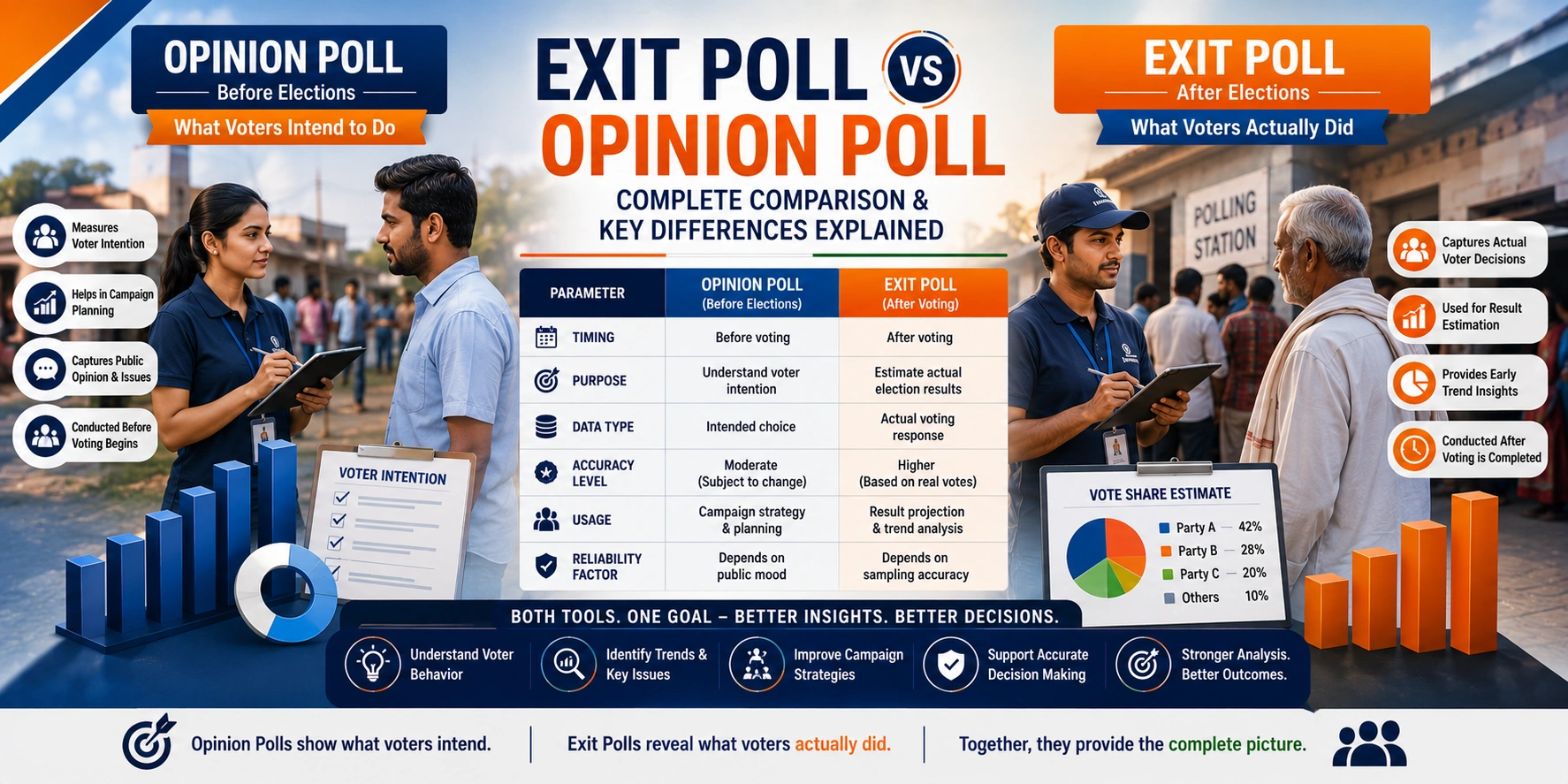
Opinion Polls and Exit Polls are two important forms of election research, but they measure different stages of the electoral process. An Opinion Poll is generally conducted before voting and studies public opinion, preferences or stated voting intention at a particular point in time. An Exit Poll is conducted after selected respondents have voted and records their reported voting decision. Understanding this distinction is essential when interpreting election surveys, vote-share estimates, electoral trends and post-voting projections.
Opinion Poll = Before Voting.
It measures public opinion or stated voting intention.
Exit Poll = After Voting.
It asks selected respondents how they report having voted.
Neither poll is an official election result, and both remain subject
to sampling and other research limitations.
What is an Opinion Poll?
An Opinion Poll is a structured survey generally conducted before an election to measure public opinion, preferences, issue priorities or stated voting intention among a selected sample of respondents.
Because an opinion poll records views at the time the survey is conducted, its findings represent a snapshot of public opinion rather than a fixed prediction of what will happen on polling day.
Public opinion may change after a survey because of political developments, candidate announcements, campaign events, local issues, new information or other developments.
- Usually conducted before voting
- Measures stated public opinion
- Can study voting intention
- Can identify important public issues
- Can estimate current support levels
- Can compare changes across survey waves
- Supports pre-election research
- Represents opinion at a particular time
Read our detailed guide: What is Opinion Poll?
What is an Exit Poll?
An Exit Poll is a survey conducted after selected respondents have cast their votes. Participating voters are asked about their reported voting decision through a structured survey process.
Because voting has already taken place for the respondent, an exit poll studies reported voting behavior rather than future voting intention.
The collected responses are aggregated and analyzed statistically to estimate vote share, identify geographic patterns and, where the methodology supports it, develop broader election projections.
- Conducted after respondents have voted
- Studies reported voting decisions
- Can estimate vote share
- Can identify regional patterns
- Requires structured sampling
- Requires field data validation
- Can support seat-projection models
- Remains a statistical estimate
Read our complete guide: What is Exit Poll and How It Works in India .
Opinion Poll vs Exit Poll: The Fundamental Difference
Opinion Poll
Measures what selected respondents think, prefer or say they may do before voting.
- Pre-election survey
- Opinion or intention
- Public issues and preferences
- Can change before polling day
- Useful for trend analysis over time
Exit Poll
Measures how selected respondents report that they voted after they have completed voting.
- Post-voting survey
- Reported voting decision
- Vote-share estimation
- Conducted after the voting decision
- Useful for early post-voting analysis
Exit Poll vs Opinion Poll – Key Differences
The two survey methods can be compared across timing, purpose, respondent information, analysis and interpretation.
| Parameter | Opinion Poll | Exit Poll |
|---|---|---|
| Timing | Generally conducted before voting | Conducted after selected respondents have voted |
| Main Purpose | Measure public opinion or stated voting intention | Study reported voting decisions |
| Type of Information | Current opinion, preference or intention | Reported post-voting choice |
| Stage of Election | Pre-election period | Voting / post-voting period |
| Possibility of Change | Respondent opinion can change before voting | The respondent has already voted |
| Research Output | Opinion trends, issue priorities, support estimates | Vote-share estimates and post-voting patterns |
| Seat Projection | May be modelled from pre-election estimates | May be modelled from post-voting estimates |
| Key Challenge | Opinion may change after the survey | Coverage, non-response and field execution |
| Official Result? | No | No |
How Opinion Poll and Exit Poll Methodology Differ
Both methods use survey research, but the field environment and research objective are different.
Opinion Poll Methodology
Opinion-poll methodology is designed to measure public views before voting.
- Define target research population
- Develop sampling framework
- Select survey locations or respondents
- Design neutral questionnaire
- Conduct field, telephone or permitted digital research
- Validate collected responses
- Analyze aggregate survey data
- Report findings with appropriate limitations
Exit Poll Methodology
Exit-poll methodology focuses on respondents after they have completed voting.
- Define election and geographic scope
- Develop polling-area sampling framework
- Select field locations
- Establish respondent-selection procedures
- Collect voluntary post-voting responses
- Validate field data
- Estimate aggregate vote share
- Develop analytical reporting or projections
Common Research Workflow for Election Polls
Although the timing and purpose differ, professionally managed Opinion Polls and Exit Polls share several research-quality requirements.
Why Sampling is Important in Both Polls
Election surveys generally study a sample rather than every voter. The quality of the sampling design therefore has a major influence on how well the survey reflects the population it is intended to study.
A large sample is not automatically a representative sample. Geographic coverage, respondent selection, non-response and field execution also matter.
A professional sampling framework should therefore be based on the research objective and documented methodology rather than convenience alone.
Does a Larger Sample Always Mean a Better Poll?
No. Increasing sample size can improve statistical precision under appropriate sampling assumptions, but it cannot automatically correct a poorly designed or poorly executed survey.
For example, a very large sample collected from limited or systematically unrepresentative locations may still provide misleading estimates.
Sample size should therefore be evaluated together with sampling design, coverage, response quality, field execution and statistical methodology .
Which is More Accurate: Exit Poll or Opinion Poll?
There is no universal rule that every Exit Poll will be more accurate than every Opinion Poll.
Exit Polls have one important informational difference: participating respondents have already voted, so the survey is not asking them what they may do in the future.
However, Exit Polls can still be affected by sampling coverage, respondent refusal, reporting differences, field execution, weighting and projection-model assumptions.
Opinion Polls face many of the same survey challenges and also have the additional reality that public opinion or voting intention can change between the survey date and polling day.
Instead of asking which type of poll is automatically “more accurate”, a better question is: How strong was the sampling, fieldwork, validation and analytical methodology used in this particular poll?
Factors That Affect Poll Reliability
Reliability depends on the complete research process rather than a single factor.
Sample Design
The method used to select respondents or field locations influences representativeness.
Coverage
Inadequate geographic or population coverage can affect survey estimates.
Non-Response
People who decline to participate may differ from those who respond.
Question Design
Unclear or leading questions can affect the quality of collected information.
Field Execution
Inconsistent respondent selection or interviewing procedures can introduce error.
Data Quality
Incomplete, duplicate or inconsistent records require systematic validation.
Weighting
Statistical adjustments depend on assumptions and should be applied transparently.
Timing
Timing is especially important for opinion polls because public views can change.
Modelling
Translating survey estimates into seat projections introduces additional assumptions.
Margin of Error and Survey Uncertainty
Because election polls use samples, their estimates involve statistical uncertainty.
A reported margin of error may describe sampling uncertainty under specific statistical assumptions, but real-world surveys can also be affected by other sources of error.
- Sampling error
- Coverage error
- Non-response
- Measurement or questionnaire effects
- Field implementation differences
- Data-processing decisions
- Weighting assumptions
- Projection-model uncertainty
For this reason, poll findings should be interpreted as estimates rather than guaranteed outcomes.
Vote Share Estimation in Opinion Polls and Exit Polls
Both Opinion Polls and Exit Polls can be used to develop aggregate vote-share estimates, but the underlying information differs.
Opinion Poll Vote Share
Estimates are based on respondents' stated preferences or voting intentions at the time of the survey.
Exit Poll Vote Share
Estimates are based on how selected respondents report having voted after casting their votes.
In both cases, the quality of the estimate depends on the sample, response patterns, field execution and analytical methodology.
Can Both Opinion Polls and Exit Polls Predict Seats?
Survey findings may be used as inputs for statistical seat-projection models, but a seat projection is not the same thing as a raw survey result.
Converting estimated vote share into seats may require additional information and assumptions concerning constituency-level variation, historical results, regional patterns, alliances and electoral competitiveness.
Seat projections should therefore be communicated as model-based estimates rather than guaranteed results.
Why Opinion Polls Can Change Over Time
Opinion polls measure views at the time the research is conducted. They do not permanently fix respondents' future choices.
Public opinion may change because of:
- New political developments
- Candidate announcements
- Campaign events
- Local issues
- Public debates
- New information
- Changes in political alliances
- Events occurring after the survey
Comparing multiple survey waves can therefore be more informative for trend analysis than treating one poll as a permanent forecast.
Why Exit Polls Can Still Differ from Official Results
An exit poll surveys only a sample of voters and therefore does not directly count every vote.
Differences between an Exit Poll estimate and the final official result can arise from:
- Sampling limitations
- Uneven geographic coverage
- Respondent refusal
- Differences in response patterns
- Field execution issues
- Weighting assumptions
- Constituency-level variation
- Seat-projection modelling
The official election result comes only from the formal counting process conducted by the relevant election authorities.
Digital Data Collection and Polling Technology
Modern survey technology can support both Opinion Poll and Exit Poll operations by connecting field teams with centralized data systems.
Depending on project requirements, technology may support:
- Digital questionnaires
- Mobile survey applications
- Field-progress monitoring
- Centralized data transmission
- Automated validation checks
- Survey dashboards
- Statistical analysis
- Structured reporting
Technology improves operational efficiency, but it cannot substitute for proper sampling, neutral research design or disciplined fieldwork.
Privacy, Confidentiality and Data Governance
Election research can involve sensitive information, particularly when respondents are asked about political preferences or voting choices.
Professional survey operations should therefore use appropriate safeguards for data collection, access, transmission, analysis and reporting.
- Voluntary participation
- Clear research purpose
- Minimal necessary data collection
- Appropriate confidentiality
- Controlled system access
- Secure data handling
- Aggregate reporting where appropriate
- Documented data-quality procedures
Role of Opinion Polls and Exit Polls in Election Analysis
The two methods provide information at different points in the electoral cycle.
Before Voting
Opinion Polls can help researchers understand current public opinion, issue priorities, electoral trends and changes across successive survey periods.
After Voting
Exit Polls can help researchers analyze reported voting patterns and develop early post-voting vote-share estimates and broader electoral analysis.
When interpreted responsibly, the two methods can contribute to a broader understanding of how the electoral environment changes from the pre-election period to the post-voting stage.
Neither an Opinion Poll nor an Exit Poll is an official election result. Opinion Polls measure survey responses before voting, while Exit Polls collect post-voting survey responses. Official election results are determined only through the formal counting process.
Challenges in Opinion Polls and Exit Polls
Sampling Error
A sample cannot reproduce the entire electorate perfectly.
Non-Response
Some selected respondents may decline to participate.
Coverage
Limited geographic or population coverage can affect survey estimates.
Field Quality
Inconsistent interviewing or respondent selection can weaken research quality.
Data Processing
Incomplete or inconsistent records require systematic validation.
Interpretation
Survey estimates can be misunderstood when uncertainty and methodology are not communicated clearly.
Best Practices for Professional Election Polling
High-quality election polling requires consistency throughout the complete research lifecycle.
- Clearly define research objectives
- Use a documented sampling framework
- Design neutral questionnaires
- Train field survey teams
- Maintain consistent respondent selection
- Use appropriate quality-control procedures
- Validate data before analysis
- Document weighting and analytical methods
- Protect respondent information
- Communicate limitations clearly
Opinion Polls and Exit Polls in India
India's electoral scale, geographic diversity and multi-phase elections can make large survey projects operationally complex.
Research teams may need to coordinate field operations across constituencies and polling phases while maintaining consistent sampling, questionnaire administration, data validation and reporting procedures.
Election research and the publication or dissemination of poll findings should also be planned with attention to applicable election laws, Election Commission directions and restrictions in force for the relevant election and period.
Why Professional Polling Methodology Matters
Professional polling requires much more than collecting a large number of responses.
A complete research operation can involve:
- Research planning
- Sample design
- Questionnaire development
- Field-team deployment
- Digital survey systems
- Centralized data management
- Quality control
- Statistical analysis
- Analytical dashboards
- Structured reporting
Megamind's Approach to Opinion Poll & Exit Poll Research
Megamind approaches election polling as an integrated combination of research methodology, field operations, technology, data management, validation and statistical analysis.
Depending on the project, our research framework can include:
Research Objective → Sample Design → Questionnaire → Field Planning → Survey-Team Deployment → Digital Data Collection → Validation → Statistical Analysis → Analytical Reporting
Opinion Poll projects focus on measuring public opinion and stated preferences before voting, while Exit Poll projects focus on post-voting research and reported voting decisions.
Our emphasis is on structured methodology, disciplined field operations, reliable data management and transparent interpretation of survey findings and limitations.
Explore Opinion Poll Services →Explore Exit Poll Services →
FAQs – Exit Poll vs Opinion Poll
What is the main difference between an Opinion Poll and an Exit Poll?
An Opinion Poll is generally conducted before voting and measures public opinion or stated voting intention. An Exit Poll surveys selected respondents after they have voted.
When is an Opinion Poll conducted?
Opinion Polls are generally conducted before voting to study public opinion at a particular point in the election cycle.
When is an Exit Poll conducted?
Exit Poll surveys are conducted after selected respondents have cast their votes, subject to applicable election rules and field requirements.
Does an Opinion Poll show the final election result?
No. It measures survey responses at a particular point before voting and should not be treated as an official result.
Is an Exit Poll the official election result?
No. An Exit Poll is a statistical survey estimate. The formal result comes from the official counting process.
Is an Exit Poll always more accurate than an Opinion Poll?
No universal rule guarantees this. Exit Poll respondents have already voted, but reliability still depends on sampling, coverage, non-response, fieldwork and analytical methodology.
Can Opinion Poll results change before an election?
Yes. Opinion Polls measure views at the time of the survey, and public opinion can change before voting takes place.
Can both polls estimate vote share?
Both can produce aggregate vote-share estimates, but Opinion Polls use stated pre-election preferences while Exit Polls use reported post-voting choices.
Can both polls be used for seat projections?
Survey estimates may be used as inputs into seat-projection models, but those projections involve additional assumptions and are not official results.
Why can different polling agencies produce different results?
They may use different samples, geographic coverage, questionnaires, field procedures, weighting methods and statistical models.
What affects the reliability of an election poll?
Important factors include sampling design, sample coverage, response quality, field execution, data validation, weighting and analytical methodology.
Why is respondent privacy important?
Political preferences and voting choices can be sensitive information, so responsible survey operations should use appropriate confidentiality and data-protection practices.
Why are professional field teams important?
Trained field teams help maintain consistent respondent selection, questionnaire administration, data collection and reporting procedures.
What is more important: sample size or sampling quality?
Both matter, but a very large poorly selected sample does not automatically produce a reliable survey. Sample quality, coverage and methodology are critical.
Opinion Poll and Exit Poll Measure Different Stages of an Election
Opinion Polls and Exit Polls are related forms of election research, but they answer different questions.
An Opinion Poll measures public opinion, preferences or stated voting intention before voting. An Exit Poll studies how selected respondents report having voted after they have cast their votes.
The value of either poll depends on more than its label. Reliable election research requires sound sampling, neutral questionnaires, disciplined fieldwork, data validation, statistical analysis and transparent reporting .
Neither survey should be treated as an official election result. Both provide statistical evidence that should be interpreted together with their methodology, timing and limitations.